

Practical guide to recognizing and playing the Japanese pentatonic scale on your instrument. This article clearly explains what a tongue drum is, how it produces notes, and why its construction affects its sound.
A tongue drum generally has between 6 and 15 notes, sometimes 18. It consists of a steel shell with tongues cut into it, giving it a sound rich in harmonics.
The limited number of notes calls for a thoughtful choice of scale and key. Major and minor keys evoke different emotions; the Japanese pentatonic scale is known for its hypnotic, introspective effect.
This guide prepares you to compare the Amara, Celtic, Hijaz, and Pygmy scales, understand the emotions associated with different keys, and take your first steps toward playing and choosing an instrument with confidence.
Why It Matters Today in France and What You Will Learn
The Japanese pentatonic scale is increasingly appealing to musicians and wellness practitioners in France.
Why people seek it out: its sounds are exotic and soothing, and they suit sound yoga, meditation, and free creation. Players choose a key according to what they want: a major key for joy or a minor key for introspection.
What you will learn here: the scale’s structure, the emotions linked to different keys, practical applications, and useful criteria for choosing an instrument before you buy.
Among instruments with tuned tongues, each key defines a particular palette. Relaxation practices often favor pentatonic scales, which are accessible even to beginners.
| Use | Mood | Recommended for |
|---|---|---|
| Meditation & relaxation | Hypnotic, gentle | Practitioners, beginners |
| Free creation | Evocative, colorful | Composers, improvisers |
| Learning | Accessible, reassuring | Beginners, often in C or D major |
You will come away with practical ways to assess your choice and ideas for learning: start in a major key, then explore the pentatonic palette to deepen your knowledge.
Essentials: Scales, Keys, and the Number of Notes on a Tongue Drum
The number of available notes often determines how a tongue drum can be used musically.
What is a scale? It is an organized set of notes that determines the melodies and harmonies you can play on the instrument.
Diatonic and Pentatonic Scales: Useful Definitions
A diatonic scale has 7 notes, such as C, D, E, F, G, A, and B. It works well for familiar tunes and structured melodies.
A pentatonic scale has 5 notes. It is intuitive and ideal for free improvisation and relaxation because it greatly reduces the chance of playing a discordant note.
“Early handmade models, often made from gas cylinders, naturally favored pentatonic arrangements.”
The Tongue Drum’s Limited Range: How It Affects Note Selection
A piano spans more than 7 octaves with its 88 keys. By comparison, a tongue drum generally has 6 to 15 notes, sometimes 18, making the choice of scale especially important.
- Advantage: fewer notes let you focus more on resonance and phrasing.
- Use: a diatonic scale suits familiar tunes, while a pentatonic scale suits meditation and improvisation.
- Design: the instrument’s construction determines the choice of tongues and, therefore, your sound palette.
To choose, consider your goals: structured learning or sensory exploration. For a guide to the number of notes suitable for beginners, see which tongue drum to choose as a beginner.
Akebono on the Tongue Drum: Understanding This Scale
On a tongue drum, the Japanese pentatonic structure provides a foundation for meditative improvisation.
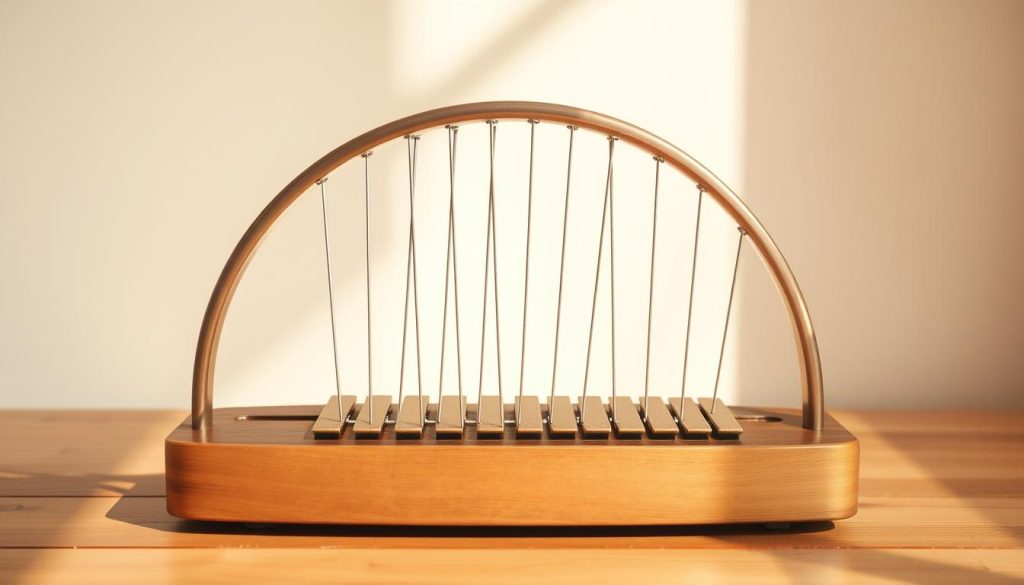
Origins and Pentatonic Character
Rooted in Japanese tradition, the pentatonic scale evokes the sounds of the koto and shamisen. It uses five notes chosen for how well they work together.
Sound, Emotion, and Purpose
Its tone combines an exotic quality with depth. It encourages introspection and long sessions of meditation.
Gentle repetition creates a hypnotic setting. The space between strikes invites mindfulness.
Intervals and Tongue Layout
The scale’s notes are arranged to limit dissonance. Wide intervals help keep tension out of the melody.
Practical tip: favor fluid movements between the root note and nearby notes. Work with sustained resonance and restraint to build airy textures.
“Fewer notes, more meaning: what matters most happens in the space between sounds.”
To explore how the choice of key relates to the choice of instrument, consult a guide to tongue drum scales and keys.
Differences Between Akebono, Major Scales, and Minor Scales
Depending on the key, the same melody can evoke celebration, sadness, or meditation. Here we compare these moods to help you choose.
Moods and Feelings: Joyful, Melancholy, or Hypnotic
A major scale creates a sense of joy, warmth, and celebration. It energizes listeners and invites movement.
A minor scale tends toward melancholy and introspection. It calls for softer attacks and longer notes.
The Japanese pentatonic scale has an exotic, hypnotic quality. It steadies attention and encourages contemplation.
When to Choose Each Key for Your Musical Goals
For playful workshops or familiar tunes, favor a major key. C major and D major are good starting points.
Choose a minor key for relaxation sessions or moving melodies. D minor is often popular for this purpose.
- Playing the same pattern in three keys reveals how each one feels different.
- Adjust the attacks, silences, and sustained resonance to achieve the effect you want.
- Onstage, the key guides the audience; in sound therapy, it shapes the experience.
“Comparison helps refine your choice: recording each attempt makes it easier to identify your preference.”
To learn more about the relationship between key and instrument, consult our guide to tongue drum scales and keys.
Playing Akebono on Your Tongue Drum
A simple visual map makes playing easier. Find the root note in the center of the circular layout, then locate the nearby notes.

Tongue Layout and Visual Guides
Circular layout: locate the notes arranged in a circle. Mark the root and the two nearby notes with subtle colors.
If your instrument has paired tongues, identify them to enrich the tone.
Playing with Fingers and Mallets
Playing with your fingers offers more expression and lets you play ghost notes. Mallets produce a fuller, clearer sound.
Tip: favor your fingers for meditation and subtle expression, and mallets for longer resonance.
Melodic Patterns and Breathing
Start with three stable notes. Play slowly at a low tempo, using gentle attacks and carefully controlled releases.
- Alternate widely spaced strikes with silences to make use of sustained resonance.
- Change just one note in a pattern to create small variations.
- Record your sessions to assess the rhythm of your breathing and the coherence of your melodies.
“Start simply: three notes, measured movements, and let the resonance speak.”
Progressive Exercises for Learning Akebono
Progressive exercises help you bring the pentatonic sound into your playing. Begin with slow, repeated movements to coordinate your breathing and touch.
Simple Pentatonic Warmups
Slow arpeggios: play the root, then nearby notes, giving each the same duration. Repeat the exercise 4 to 8 times.
Alternating hands: switch between your right and left hands to improve independence and fluency.
Slow Rhythmic Patterns for Music Therapy
Create minimal patterns of 2 to 4 strikes to establish a steady pulse. Keep a consistent tempo and let the notes ring.
“Breathing with the phrasing anchors your attention.”
Building Meditative Melodies and Small Variations
Change an accent, reverse an interval, or delay a note. These small variations enrich melodies without making them complicated.
Introduce a gradual change in volume: a gentle crescendo followed by a decrescendo over 4 to 8 measures.
Moving Toward Guided Improvisation
Set a framework of 3 to 5 notes with a calming intention. Establish a tempo and improvise as a duo: one person plays a basic pattern while the other adds a free melodic line.
Write down your favorite sequences to build a personal repertoire. You can also move these exercises to a minor scale for a different sound.
For information on tuning and frequency, see the 432 Hz tuning guide.
Choosing an Akebono Tongue Drum: Key, Models, and Goals
The diameter and number of notes directly affect your instrument’s sonic character.
A larger instrument offers longer resonance and stronger bass notes. This creates an enveloping sensation that suits relaxation and sound yoga.

Number of Notes and Diameter: How They Change the Sound
As the number of notes increases from 8 to 15, the melodic palette expands. Pentatonic models encourage instinctive improvisation. Diatonic arrangements let you play familiar tunes and read sheet music.
Common Keys, Perceived Pitch, and Relaxation
C major, D major, and D minor are common keys. Always listen to audio demonstrations to check how the tongue drum’s key sounds in a wellness setting.
Pentatonic and Diatonic Models for Mixed Uses
Depending on your goals, favor a pentatonic model if you want a simple instrument for meditation. For teaching or performing, choose a diatonic scale or an instrument with more tongues.
| Model | Strength | Typical notes | Ideal for |
|---|---|---|---|
| Beat Root | Magnets for fine tuning | 8 to 12 | Precise adjustments, recording |
| RAV Vast | Rich resonance | 8 to 11 | Relaxation, concerts |
| Zenko / Moozica | Careful finishing / paired tongues | 8 to 15 | Teaching, a wider palette |
Listen to demonstrations and test how easily you can reach the tongues before buying. To compare keys and models, see our guide to tongue drum scales and keys.
A Useful Comparison: Akebono, Amara, Celtic, and Other Scales
You can hear the differences between scales from the first few notes. This brief comparison helps you choose according to the mood you want and your experience level.
Amara or Celtic Minor: An Intuitive, Harmonious Hexatonic Scale
Amara is a highly musical hexatonic scale. Its intervals give rise to flowing melodies.
Ideal for beginners, it makes playing and spontaneous creation easier.
Hijaz, Pygmy, and Low Pygmy: Sounds and Difficulty Levels
Pygmy remains pentatonic and dreamy. It sounds melancholy and is easy to improvise with.
Low Pygmy offers deeper bass notes and requires greater precision.
Hijaz introduces a Middle Eastern sound rich in tension. Its character is appealing, but it requires greater control of phrasing.
- Playing: adapt your patterns and handling of sustained resonance to the key.
- Layout: the number of notes and placement of the tongues affect your access to different sounds.
- Limits: a diatonic scale offers more melodic possibilities; a pentatonic scale makes improvisation easier from the start.
“Exploring several scales enriches a musician’s sonic vocabulary.”
Tip: start with an intuitive scale such as Amara or Pygmy, then try models with a more distinctive character. To compare and hear similar instruments, explore a model such as the handcrafted handpan 67.
Tuning, Magnets, and Multi-Scale Instruments: What Is Possible
Before making any changes, remember that tuning a steel instrument is delicate. An unskilled adjustment can affect its resonance and make repair impossible.
What Neodymium Magnets Do and Their Limits
Placing magnets beneath a tongue adds weight and lowers its pitch slightly. Effect: small adjustments that help balance nearby notes.
Limits: the reduction in pitch is slight and reversible, but the effect on tone can be noticeable. For fine adjustments, favor models designed with this system, such as Beat Root.
Risks of Cutting and Other Irreversible Changes
Sawing or lengthening a tongue permanently changes its note. Warning: do not cut a tongue without the necessary expertise. You risk damaging tuning stability and the quality of sustained resonance.
440 Hz and 432 Hz Tuning and Multi-Scale Instruments
Choosing between 440 and 432 Hz changes the overall perceived pitch, but it does not change the structure of a scale or its basic key.
Some multi-scale instruments have adjustable magnets. They offer creativity and flexibility, but they are expensive, often have relatively few notes, and require reconfiguration between pieces.
“Choose the right key from the outset: it is the most reliable way to match the instrument to your playing.”
- Check tuning stability after any adjustment.
- Favor buying a suitable pentatonic or diatonic model over modifying one.
Practical Applications: Meditation, Sound Yoga, and Music Therapy with Akebono
Simple, repeated patterns can anchor the breath and encourage inward listening. Easy to use, the tongue drum becomes a useful tool in music therapy and meditation. The low risk of discordant notes reassures participants and helps them take part.
Creating Soothing, Repetitive Soundscapes
Start with a three-note pattern, played slowly and repeated. Let the resonance fill the space between strikes.
Tempo: 40 to 60 beats per minute, with gentle attacks and long pauses that highlight sustained resonance.
Make silence an integral part of the music. It encourages attention and strengthens the therapeutic effect.
Structuring a Session: Opening, Peak, and Return to Calm
Opening: use breath awareness and repeated, light strikes to establish a steady rhythm.
Controlled build: gradually increase the intensity or add a nearby note to create a brief emotional peak.
Return to calm: slow the tempo and soften the attacks, then finish with three widely spaced strikes and a long silence.
- Placement: put the instrument in the center, in front of the group, 1 to 3 m from the audience, on a slightly resonant surface.
- Collaboration: pair it with singing bowls or small gongs. Set their volume so they do not drown out the main resonance.
- Transitions: change the pattern, vary the intensity, or slow the tempo to guide the experience.
- Ethics: obtain consent, adapt the session to participants’ needs, and observe their reactions.
- Professional practice: document your methods and note perceived effects to refine your sequences.
“The emotional steadiness offered by this key makes it easier to return to a calm state with regular practice.”
Conclusion
The ideal key depends on how you plan to use the instrument: for familiar tunes, improvisation, or relaxation. Akebono is a pentatonic scale suited to introspection, a major key invites joy, and a minor key encourages melancholy.
To choose well, listen to and try several models. Consider their diameter and number of notes before thinking about later modifications.
Here is a simple plan: review the essentials, practice the exercises, build your patterns, and record your sessions. Note how you feel to strengthen your knowledge.
Explore other scales, such as Amara, Pygmy, and Hijaz, to enrich your sound world. Combining playing with breathing and mindfulness strengthens its calming effect.
Finally, whether you are starting out or improving, regular practice and intention bring enjoyment, control, and life to the music you play on your tongue drum.