

Setting the scene: this guide shows how pentatonic scales make music more accessible. They give learning a structure and let beginners play without a complex knowledge of music theory.
The tongue drum is an idiophone with tuned tongues, popularized by Dennis Havlena. It draws on ideas from the Whale Drum and the Hang and produces a gentle, intuitive sound.
This guide covers choosing a model, the difference between major and minor scales, setting up a scale, tuning, and then rhythm and improvisation exercises. Concrete examples, such as C major: C‑D‑E‑G‑A and A minor: A‑C‑D‑E‑G, provide useful reference points.
Key benefits: a focus on musicality, less harmonic complexity, and the ability to play melodies right away. You will also find pointers for getting started, exercises, and resources such as tongue drum sheet music and tutorials.
The ultimate goal is to play simple patterns, build musical phrases, and improvise confidently while enjoying this instrument’s soothing qualities.
Why pentatonic scales transform your tongue drum playing
Reducing the number of notes makes musical expression on this instrument easier right away. The five-note scale omits two potentially tense scale degrees, greatly reducing the risk of dissonance.
This choice encourages resonance and clear patterns. In a relaxation setting, fewer notes leave room for sustain and reveal the richness of the tongue drum’s timbres.
Fewer decisions with each strike free your mind to focus on rhythm, dynamics, and tone color. Players gain confidence and learn faster.
“Limiting your vocabulary helps you learn melody.”
- Composing becomes easier: just two notes can quickly form a coherent phrase.
- Alternating among the five notes creates effective melodic cycles in many musical settings.
- Tips: listen as the sounds fade, give your patterns room to breathe, and start with simple phrases.
| Benefit | Effect | Tip |
|---|---|---|
| Less dissonance | Natural harmony | Improvise without fear |
| Greater resonance | Noticeable sustain | Space out your strikes |
| Quick learning | Easier to remember note positions | Practice four-beat patterns |
Tongue drum essentials and how it resonates
Each part—the tongue, hollow body, and opening—plays a specific role in producing sound.
How the tongues, notes, and resonating chamber work
The tongue drum is an idiophone: its metal vibrates to produce notes without strings or a membrane.
The cut tongues determine pitch: wider tongues produce lower sounds, while smaller ones produce higher sounds. Their shape affects tuning and projection.
The resonating chamber amplifies these vibrations. An opening beneath the instrument lets you filter the sound by covering or uncovering it.
Steel tongue drum, tank drum, hank drum: understanding the names
The terms steel tongue drum, tank drum, and hank drum refer to related steel instruments. They have much in common.
A handpan, by contrast, is hammered rather than cut: it produces its tone in a different way.
- Typical volume: 70 to 80 dB, suitable for indoor wellness sessions.
- Surface and diameter: a small instrument gives a crisp attack; a large one has more sustain.
- In practice, your choice of mallet, control of dynamics, and hand placement all shape the resonance.
“With a little basic knowledge, you can produce a beautiful sound quickly.”
Choosing the right instrument for pentatonic playing
The number of tongues and the diameter together determine the character of the sound. Your choice affects the range, ease of learning, and how you can use the instrument.
Number of tongues and range
Models with 6 to 11 tongues work very well for relaxation and meditation. Their limited range of notes makes them intuitive.
To play familiar pieces from sheet music, aim for around 15 notes. This expands your repertoire and lets you perform written pieces.
Tip for beginners: 9 to 11 notes offer a good balance of possibilities and simplicity.
Diameter, depth, and sustain
A small diameter of 20 to 25 cm produces less resonance and suits fast, staccato playing.
A large instrument of at least 40 cm offers depth and long sustain, ideal for slow playing and sustained soundscapes.
Reference frequencies and materials
The Western reference is 440 Hz when playing with other musicians. Some models tuned to 432 Hz or 528 Hz are sought after for wellness activities.
The steel and build quality affect tuning stability and longevity. Try several models before buying.
- More notes: a wider repertoire.
- Fewer notes: intuitive playing and controlled resonance.
- Choose according to your intended use: relaxation, improvisation, accompaniment, or reading sheet music.
Pentatonic scales on the tongue drum: a practical guide
A simple choice of notes can shape the feeling of a piece. The major scale often sounds bright and energetic. It lends itself to cheerful, open patterns.
The minor scale creates a more intimate, melancholy mood. The same five notes, arranged differently, change the character without making the instrument harder to play.
Recommendations for beginners
If you are a beginner, start with C major and A minor. These scales let you create pleasing melodies right away and are easy to remember.
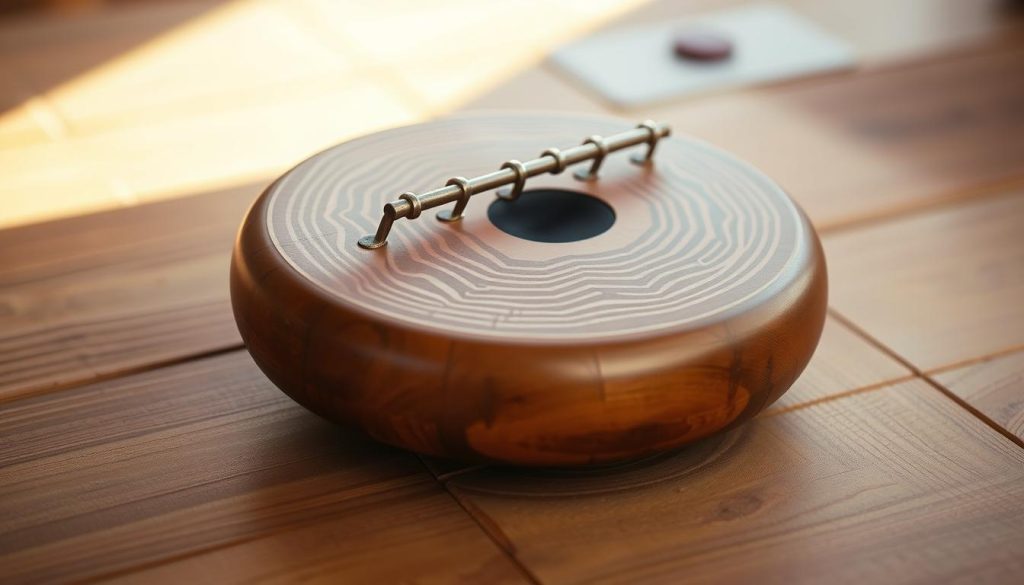
- Simple intervals: notes separated by whole and half steps available on the instrument.
- Stability: five notes are enough to avoid harmonic tension.
- Quick method: first repeat groups of two or three notes, then move to four or five to build a melody.
Sing the melody before playing to strengthen your aural memory. Alternate low and high notes to vary the dynamics.
“Start small, record your attempts, and keep the patterns that speak to you.”
To go further, explore tongue drum sheet music and build a library of your own patterns.
Tuning and checking your pentatonic scale: tools and method
Before making any changes, prepare a quiet space and a precise tuner so you can work one note at a time.
Essential equipment: a reliable electronic tuner adjustable from 435 to 445 Hz, a tuning fork for reference, and magnets designed for your model.
Checking notes and making fine adjustments
Play each tongue separately. Measure and record how many cents it differs from the target pitch.
Move the magnets only a few millimeters at a time: toward the center to lower the frequency, or toward the edge to raise it. Check the result with the electronic tuner after each move.
Step-by-step procedure
- Identify the note that is out of tune.
- Measure the difference with the tuning fork and tuner.
- Adjust the magnet in very small increments.
- Check and record the result.
Care and stability
Place the instrument on a stable, cushioned support. Work in a room free of drafts.
Limit exposure to moisture, clean the instrument gently, and consider applying a thin coat of linseed oil to prevent corrosion.
“Patience and small corrections work better than one big move.”
| Tool | Use | Tip |
|---|---|---|
| Electronic tuner | Precise measurement in cents | Set it to 440 Hz or the reference for your model |
| Tuning fork | Pitch reference | Use it for the base note |
| Magnets | Fine adjustment of notes | Make small moves and test repeatedly |
| Silica gel | Storage | Prevent moisture and corrosion |
Tip: after tuning, play a slow sequence of notes on the tongue drum to check that the scale sounds coherent.
Setting up your first pentatonic scale on the instrument
Start by mapping the layout of the tongues. Identify each tongue by sight, write down its note name, and draw a simple diagram of the playing order. This helps you remember the positions and gives you a quick reference at each step.
Finding the notes and choosing a playing order
Check whether the maker alternates positions for the right and left hands. Try circular paths that follow the layout of the tongues. Play up and down the scale, then skip a note to hear the interval.
Adapting your striking technique and controlling dynamics
Play with your fingers for more nuance. Use mallets for consistent projection. Practice three dynamic levels: pianissimo, mezzo-forte, and forte. Space out your strikes to manage sustain.
- Exercises: alternate right and left hands, play circular patterns, and ascend and descend the scale.
- Posture: keep your torso upright and wrists relaxed, and let each strike rebound to preserve resonance.
- Short exercise: record a simple pattern, listen to it, and adjust the dynamics.
“Mapping and then repeating turns discovery into instinct.”
Practical pentatonic scales for the tongue drum
These scales give you starting points for quickly creating soothing melodies. They are easy to remember and work well on most metal instruments.
C major (C‑D‑E‑G‑A)
Notes: C – D – E – G – A.
Suggested starting pattern: 1‑2‑3‑2‑1, going up and back down. Play slowly to hear the major sound.
A minor (A‑C‑D‑E‑G)
Notes: A – C – D – E – G.
The mood becomes more intimate and melancholy. Try the same 1‑2‑3‑2‑1 pattern to compare how each scale feels.
D minor / Amara (on a nine-note instrument)
On a model with nine tongues, D minor (Amara) offers a good balance between simplicity and richness.
Its stable soundscape makes it particularly popular for wellness and meditation.
- Suggestion: play a sequence such as 1‑2‑3‑5‑6, then add rhythmic variations to create an expressive melody.
- Check each note with an electronic tuner before recording or playing with others.
- Contrast exercise: play the same pattern in C, then in A, and notice the change in mood.
- Play slowly to give the resonance room to breathe; notice how the instrument’s diameter affects sustain.
- Record your scales and tongue diagrams in a notebook to build a personal repertoire.
| Scale | Notes | Suggested use |
|---|---|---|
| C major | C‑D‑E‑G‑A | Bright melodies, beginners |
| A minor | A‑C‑D‑E‑G | Relaxing moods, introspection |
| D minor (Amara) | Nine notes (variations) | Meditation, soundscapes |
Rhythm, beats, and patterns: shaping pentatonic phrases
Giving rhythm a structure turns a sequence of notes into a musical phrase. A simple rhythmic framework makes your playing easier to follow and leaves room for improvisation.
Simple ostinatos for the right and left hands
Even-beat ostinatos: alternate right and left hands in eighth notes to establish the tempo. On a small instrument, favor compact, clearly marked patterns.
Triple-beat ostinatos: a 1‑2‑3 sequence in triplets creates a rounded pulse. Larger instruments let you leave more breathing room between loops.
- Start with a metronome at a slow tempo, steady the rhythm, then gradually increase the speed.
- Record an ostinato and improvise over it with two or three notes to test the harmony.
Syncopation and pauses that let the resonance sing
Introduce simple syncopation: offbeats and anticipations create movement without complicating the phrase.
Musical breathing: leave silences so the instrument’s resonance can develop. This prevents frequencies from piling up.
Work on dynamics: lightly emphasize certain beats to shape the melodic line. Tightly spaced patterns suit fast playing; spacious phrases make the most of larger models.

“A simple pulse turns your patterns into phrases that breathe.”
From your first pattern to a melody: progressive exercises
A quick warm-up prepares your body and ears. Begin by practicing gentle strikes and controlling the rebound. Follow with three- or four-note arpeggios to loosen your hands.
Warm-ups, arpeggios, and smooth transitions
Group neighboring notes first, then add leaps to vary the melodic contour. Build accuracy by playing softly, then strike harder to feel the difference in dynamics.
Building four- to eight-beat patterns and variations
Give each pattern a beginning, middle, and end. Create two or three rhythmic variations and repeat them several times so you remember them while keeping the expression flexible.
- Four-beat patterns: a simple A–B–A–ending sequence.
- Eight-beat patterns: combine two four-beat phrases.
- Repeat five to ten times, then vary the dynamics.
- Use tongue drum sheet music or video tutorials to see how the movements work.
“A few minutes each day improve your listening and ease of playing.”
Mini performance: play two four-beat patterns in succession, then add a variation. Aim for a steady tempo and a beautiful sound.
Pentatonic improvisation: creativity and harmony
Improvising with a small set of notes quickly opens up possibilities for making music together. Harmony becomes easier to manage, freeing you to experiment with rhythm and tone color.

Playing call and response and developing a theme
Play a short phrase as a call, then answer it by changing the rhythm or one note. Repeat a central pattern, changing an accent or a note in each cycle.
Tip: keep the call short—two to four strikes—and give the response room to breathe so the melody stands out.
Accompanying a guitar, steel drum, or handpan
Choose a complementary range and favor ostinatos. Listen to the other musicians and avoid masking the sustain of this distinctive instrument.
- Use shared notes as anchors to make transitions stable.
- Record your improvisation sessions to spot your strongest ideas.
- Small challenge: improvise with three notes at first, then gradually add more.
“Leaving space turns a group session into a real musical conversation.”
Reading and using tongue drum sheet music in a pentatonic scale
Learning to read a tongue diagram speeds up learning and memorization.
Common notation combines the letters A to G, numbers, and colored diagrams. Numbers often show the playing order; letters indicate pitch. A visual diagram shows where each note sits on your instrument.
Understanding notation and diagrams
Find the note on the diagram, then follow the indicated order. Mark fingerings and dynamics directly on the sheet music to make the performance your own.
Video tutorials and suitable sheet music
Choose tongue drum sheet music that matches your instrument’s number of notes and tuning. Videos show posture, striking angle, and hand alternation. They can help you check your first attempts.
- To make the transition from sheet music to playing by ear, listen, sing, play slowly, then speed up.
- Combine imitation and improvisation to strengthen your knowledge.
| Element | Purpose | Tip |
|---|---|---|
| Letter notation | Note pitches | Check them with a tuner |
| Numbers and diagrams | Order and position | Follow the diagram, then memorize it |
| Video tutorials | Posture and technique | Choose instruments similar to yours |
“Annotating sheet music turns a lesson into a familiar movement.”
Tongue drum and handpan: what changes for pentatonic playing
Depending on how it is made, the same scale can respond very differently under your fingers.
Construction: the tongue drum has visible, cut tongues. A handpan is hammered and has no cuts. This changes both the playing feel and how easily you can identify the notes.
Resonance and depth: a handpan often has generous sustain and very rich resonance. A steel tongue drum emphasizes a clear attack and makes note positions easy to see.
Range and scale: some handpans cover a wider range. Steel tongue drums often offer specific scales, ideal for simple pentatonic patterns.
- Ease of learning: the tongue drum is more approachable and easier to carry.
- Use: meditation, accompaniment, or outdoor performance can guide your choice.
- Diameter and design affect depth and tonal balance.

| Criterion | Steel tongue drum | Handpan |
|---|---|---|
| Construction | Cut tongues, visible note layout | Hammered note fields, sculpted shape |
| Resonance | Clear attack, moderate sustain | Long sustain, complex timbre |
| Range | Specific scale (pentatonic) | Wider range |
| Accessibility | More immediate and affordable | Requires more control and a larger budget |
Playing together: these instruments complement each other in a duo or recording. To compare models, see our full comparison of the best models.
Common pentatonic playing mistakes and quick fixes
Common problems are easy to spot when you listen to the instrument instead of forcing your movements.
A simple approach prevents most difficulties: control the strike, respect the sustain, and identify the problem precisely.
Striking too hard, muting notes, and ignoring sustain
Striking too hard produces a harsh attack and a “clicking” tone. Aim for a strike with a controlled rebound.
Avoid resting your palm or fingers too close to the tongues. Let the instrument breathe so you can enjoy its sustain.
Adapt your speed and dynamics to the diameter: larger models need more pauses to keep the notes clear.
“Wrong” notes: checking and making small adjustments
To identify an unstable note, use an electronic tuner in a quiet space. Confirm any dissonance before making changes.
Move the magnets slightly, then check the result after every move. Record their positions so you can restore the original setting if needed.
Repeat the tests several times: stability often comes from small, precise changes rather than one large adjustment.
| Problem | Diagnosis | Quick fix |
|---|---|---|
| Harsh attack | Clicking sound | Strike more gently with a controlled rebound |
| Muted note | Loss of sustain | Move your hand away and space out the strikes |
| Out-of-tune note | Difference measured in cents | Move the magnet a little and check with the tuner |
The magic of sound often comes from patience and repeated small adjustments rather than major changes.
Conclusion
To finish, C major and A minor let you play pleasing patterns right away.
The simplicity of these scales lets you make music from your first attempts. They provide a reassuring framework for improvising without worrying about wrong notes.
Build a short, regular routine: 5 to 15 minutes a day is enough to work on touch, listening, and remembering the notes.
Key technical points: control your dynamics, allow for sustain, and protect the tuning from moisture and temperature changes.
Choose an instrument suited to your wellness or group-playing goals. If needed, learn to tune your tongue drum to maintain its tuning stability.
Listen closely, let the sound fill the space, and record your progress: recordings, favorite patterns, and short four- to eight-beat compositions will strengthen your practice.
This guide and its tips are intended to help make your tongue drum a lasting musical companion that brings wellness, inspiration, and everyday magic.