
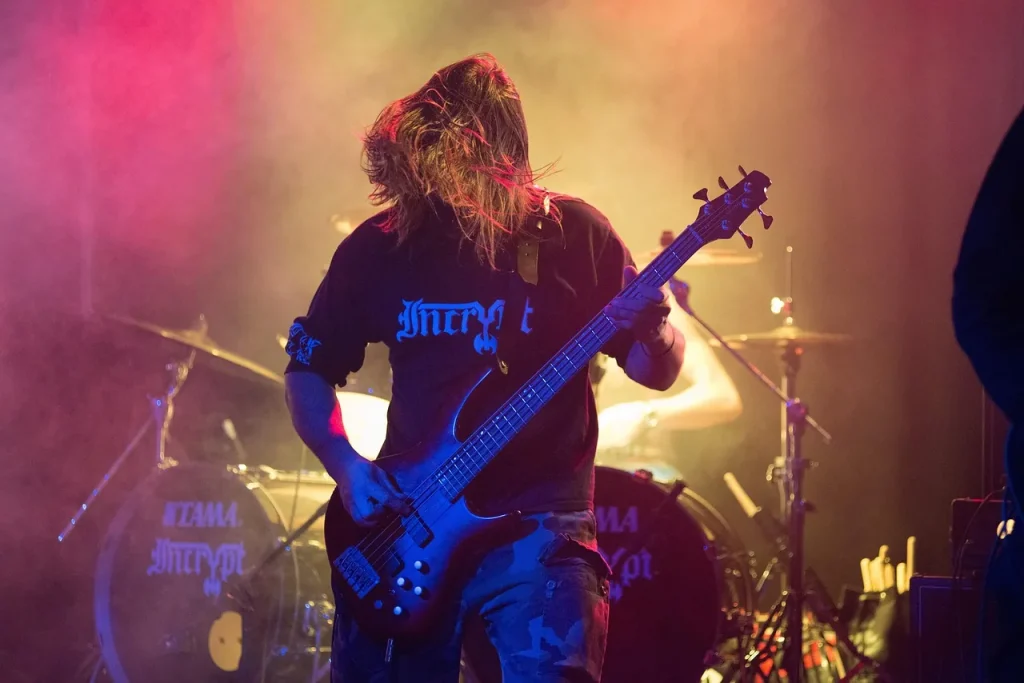
Cliff Burton was born in Castro Valley, California, on February 10, 1962. His story is bound to the rapid rise of a band that would transform the metal scene. His bass did more than follow the drums: it conversed with the guitars and sometimes carried the melody.
He joined the band in 1982 and brought a distinctive vision. His precise, dark and powerful playing gave the bassist a new place in music often dominated by riffs. He wanted to be the best and sometimes practiced six hours a day.
His career ended abruptly at 24 in a tour accident in Sweden in 1986. Yet his mark remains vivid. Three studio albums testify to his talent: Kill ’Em All, Ride the Lightning and Master of Puppets.
This article looks back at his career, artistic choices and influence. This profile of the musician also helps explain why his legacy reaches far beyond his era.
Cliff Burton: The Bassist Who Shaped Metallica’s History
In Castro Valley, in the San Francisco Bay Area, his passion took shape during his teenage years. Born in February 1962, Cliff Burton began playing music at around 14. Geddy Lee, Geezer Butler, Phil Lynott and Lemmy inspired his early ambitions. They showed him that the bass could guide a song, build tension and carry a melody.
A California Childhood Shaped by Music
His surroundings also sparked his imagination. He enjoyed rock, horror films and dark worlds. He often wore a T-shirt featuring Night of the Living Dead, the 1968 film directed by George Romero.
EZ Street, Agents of Misfortune and Trauma: The Early Bands
His first band, EZ Street, included guitarist “Big” Jim Martin and Mike Bordin. Its name came from a club in San Mateo. Agents of Misfortune then gave him a chance to refine his playing. In 1982, he joined Trauma. Its sound, reminiscent of Iron Maiden, opened a new chapter in his artistic life.
“The bass should speak, not just follow.”
This experience prepared him for what came next. James Hetfield and Lars Ulrich later noticed his energy onstage. To learn more about these early years, read this profile of the musician.
The Pivotal Meeting with James Hetfield and Lars Ulrich
One night in 1982, Trauma played the Whisky a Go Go, a famous venue in Los Angeles. In the audience, James Hetfield and Lars Ulrich saw a rare stage presence. Cliff Burton’s playing went beyond the usual role of a bassist. His clear tone and energy immediately captivated the two band members.
Burton remained cautious, however. The offer did not initially appeal to him. The band’s effectiveness onstage eventually won him over. He replaced Ron McGovney toward the end of 1982. His arrival came with one condition: Metallica had to leave Los Angeles for San Francisco.

A Trauma Performance That Impressed Metallica
The move changed the band’s trajectory. Burton’s first concert with Metallica took place on March 5, 1983, at The Stone in San Francisco. The venue had previously hosted Muddy Waters, John Lee Hooker, Prince and James Brown. Guitarist Kirk Hammett soon joined the growing venture.
- Venue: Whisky a Go Go, Los Angeles
- New base: San Francisco
- First show: The Stone, March 5, 1983
| Milestone | Place | Impact |
|---|---|---|
| Trauma performance | Whisky a Go Go | Spotted by Hetfield and Ulrich |
| Joining Metallica | Los Angeles | Replacing Ron McGovney |
| First concert | The Stone | Official start of a new era |
An Innovative Bass Style Between Thrash Metal and Classical Music
As a teenager, Cliff Burton found a distinctive path. As a bassist, he turned the bass into a melodic voice through distortion, harmonies and complex lines. His influences combined metal, psychedelic rock and classical music.
Instead of following the drums, his playing conversed with the guitars. He created contrasts, eased the tension, then drove each song forward again. This approach brought unusual depth to 1980s thrash metal and placed the instrument at the heart of highly energetic compositions.
That command came from constant work. He sometimes practiced six hours a day, even after joining Metallica. His love of horror films and underground culture also fed his imagination. These influences strengthened his dark, theatrical world.
- Distortion: a more aggressive sonic presence
- Harmonies: contrasts inspired by classical music
- Melodic lines: a bass that could tell a story
This approach also sheds light on Metallica’s early albums. Later, several musicians described it as a lasting break from convention.
| Element | Function | Sonic result |
|---|---|---|
| Distortion | Strengthen the attack | An incisive presence |
| Harmonies | Add depth | Expressive tension |
| Melodic lines | Guide the composition | A central role for the bass |
Metallica’s Foundational Albums with Cliff Burton
Three albums trace the band’s artistic rise through September 1986. Each record reveals another side of Burton’s talent, combining thrash energy, melody and bold arrangements.
Kill ’Em All and “(Anesthesia) Pulling Teeth”
Released in 1983, Kill ’Em All was the first album recorded with Cliff Burton. His solo “(Anesthesia) Pulling Teeth” brought the bass to the forefront. The instrumental passage became a highlight of live shows.
“(Anesthesia) Pulling Teeth” reveals a bass capable of leading an entire piece.
Ride the Lightning and Collaborative Songwriting
Released in July 1984, Ride the Lightning marked a clear evolution. Burton took a larger role in writing with James Hetfield. For Whom the Bell Tolls, Fade to Black and Creeping Death show this new ambition.
Master of Puppets and “Orion”
Released on March 3, 1986, Master of Puppets combined power and subtlety. Burton’s knowledge of classical music enriched “Orion,” an instrumental track that showcases the bassist’s talent in metal.
- Albums: three major milestones
- Songs: strong melodic lines
- Legacy: a lasting influence
| Album | Date | Main contribution |
|---|---|---|
| Kill ’Em All | 1983 | Bass solo |
| Ride the Lightning | July 1984 | Broader songwriting role |
| Master of Puppets | March 3, 1986 | “Orion” |
The Tragedy of September 1986 During the Damage Inc. Tour
After the release of Master of Puppets, Metallica toured Europe on the Damage Inc. tour. The band was rapidly gaining an international following. Every concert brought new fans, but tragedy brought this momentum to a halt.

The Bus Crash in Sweden and the Bassist’s Death
On the night of September 26–27, 1986, the bus was traveling near Ljungby, Sweden. After a card game, Cliff Burton fell asleep in Kirk Hammett’s bunk. A few hours later, an accident sent the bus violently off the road.
The impact threw Burton from the bus. The vehicle then landed on him. He died at the scene, aged just 24. His death devastated the band and changed its course.
- Location: near Ljungby, Sweden
- Date: night of September 26–27, 1986
- Survivors: Kirk Hammett, Lars Ulrich and James Hetfield
The news struck fans and loved ones alike. For Metallica, that night marked an irreversible turning point. The metal scene lost a major figure at the height of his creativity.
Cliff Burton’s Legacy in Metal and Rock Culture
Four decades after his death, Cliff Burton remains a model for any bassist drawn to bold playing. His approach blended virtuosity, melody and freedom. It changed the place of an instrument often pushed into the background.

His three albums with Metallica continue to be studied. Their harmonies, arrangements and signature songs reveal rich songwriting. “Orion,” in particular, remains a model for several generations.
The accident in Sweden in September 1986 also added to his legendary status. He was only 24 years old. Yet his influence extends across the metal scene, far beyond a single tour.
- Artistic freedom in the face of convention
- Resistance to creative control
- Unique energy onstage
Metallica later kept his memory alive through concerts and archives. A virtual museum dedicated to his legacy extends that presence. His brief life does not diminish his work: it illuminates an artistic journey with a universal reach.
Conclusion
Through a technical and melodic approach shaped by classical music, Cliff Burton redefined the bassist’s role in Metallica. His virtuosic lines brought new strength to the band’s compositions and helped drive thrash metal’s international rise.
His contributions to Kill ’Em All, Ride the Lightning and Master of Puppets remain essential. “(Anesthesia) Pulling Teeth” and “Orion” reveal a rare creativity that musicians still study.
His death in Sweden on September 27, 1986, ended his career at 24. Yet his influence endures. Musicians and fans still honor a major figure in metal, a symbol of boldness, expression and artistic independence.