
This guide helps you learn a beginner version of this famous melody. We take a gradual, reassuring approach designed for people who are just starting out.
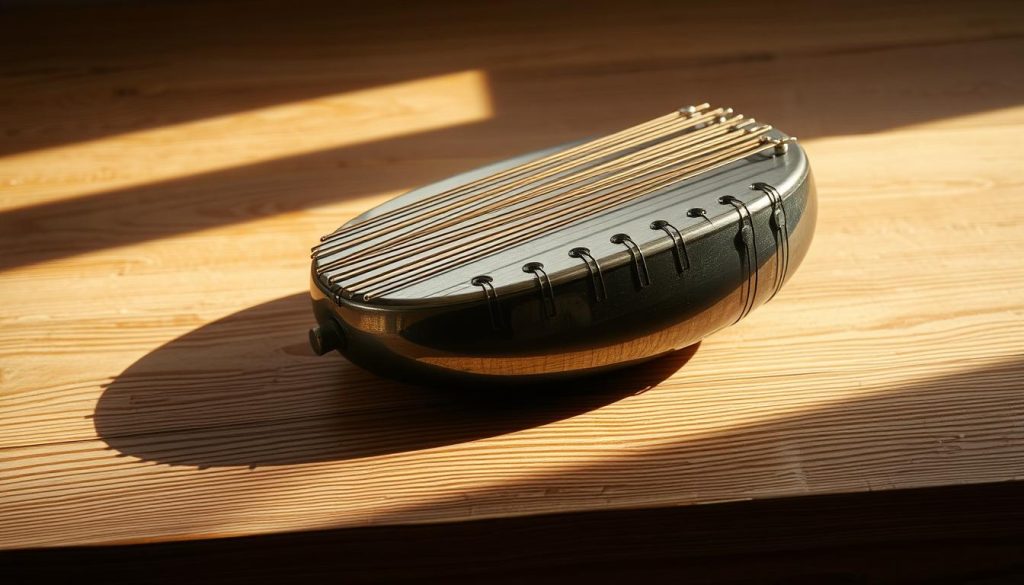
The steel tongue drum is becoming increasingly popular in France thanks to its affordable price, soothing sound and ease of use. Invented by Dennis Havlena in 2007, this instrument has a long resonance and costs much less than a handpan.
Numbered sheet music and visual markers make learning easier. According to Emmanuel Bigand (CNRS), reading music stimulates visual memory. With PDFs and tutorials, 95% of new players play their first notes within 15 minutes.
In this guide, you will follow a clear path: discover the instrument, read sheet music, master rhythm and tempo, set up your playing space, then learn the piece step by step. Quality resources and advice will help you practise with confidence.
Why use sheet music to learn the tongue drum with this guide?
Our aim is to remove the barriers associated with reading music so you can get started quickly. This comprehensive guide offers beginners a step-by-step method for making steady, confident progress.
Numbered notation (1 = C, 2 = D…) is ideal for people with no musical background. It makes reading easier and lets you tackle familiar tunes in minutes with free PDFs and tutorials.
Reading sheet music is an excellent way to structure your practice. It improves accuracy, stimulates visual memory (Emmanuel Bigand, CNRS) and strengthens hand-eye coordination.
- Clarity: a step-by-step plan for making quick progress.
- Peace of mind: avoid being overwhelmed by musical information.
- Efficiency: save time by following a gradual progression.
This guide brings together the essentials: how to read notation, keep time, position your hands and practise simple tunes. To expand your repertoire and vary your exercises, explore online resources such as a collection of song ideas and sheet music.
Discover an accessible melodic percussion instrument
With its cut-out tongues and generous resonance, this instrument makes music accessible to everyone. Made of steel, it has 6 to 17 tongues and generally sustains a note for 8 to 12 seconds. Its simple playing technique produces a warm tone and encourages regular practice.

Tongue drum and handpan: accessibility, price and ease of playing
Price and accessibility: a tongue drum generally costs 3 to 10 times less than a handpan. This difference makes it much more accessible to beginners and hobbyists.
Ease of playing: its tuning, often pentatonic, limits wrong notes. Even simple strikes sound good and encourage you to keep learning.
- Recommended French makers: Beat Root and Zenko.
- Useful resources: PDFs and tutorials to help you get started quickly.
- Suitable for all levels thanks to its forgiving tuning.
| Criterion | Instrument | Handpan |
|---|---|---|
| Price | 3 to 10 times cheaper | High cost |
| Number of notes | 6 to 17 tongues | Generally 8 to 12 notes |
| Sustain | 8 to 12 seconds | Varies, often long |
| Who it suits | All levels, quick to learn | Intermediate to professional players |
In short: this percussion instrument offers excellent value for money. Sheet music and online resources speed up progress, while its sound quality encourages you to listen to the sustain so you can shape phrases and play with nuance.
Understand how to read tongue drum sheet music
Reading a score becomes straightforward once you know the two systems used. Numbered notation (1 = C, 2 = D…) and letter notation (C, D, E…) often appear together. Learning both helps you locate each note quickly.
Octaves, chords and useful symbols
Octaves are marked with a dot above a number for a higher note or below it for a lower note. The main symbols are:
- dashes (—) to extend a note;
- vertical bars (|) to mark measures;
- parentheses (13) to play notes together as a chord.
Stickers and visual markers
Apply numbered stickers to connect the numbers and letters with their positions on the instrument. Keep a small key nearby to help you remember the matches.
A simple example: “Frère Jacques” begins 1-2-3-1. Practise with the numbers first, then check them against the letters. For more resources and other score formats, explore handpan sheet music.
Master rhythm, tempo and note length
Good rhythm turns a simple sequence of notes into a musical phrase.
Dashes, dots and bar lines: read the symbols to keep time
The symbols help you manage note lengths and place each strike. A dash (-) extends a note, a bar line (|) separates measures, and a dot adds half a note’s value to its length.
In a 4/4 score at 120 BPM, these markers make the structure clearer and help you place the strong beats.

Use a metronome to improve step by step
- Set a starting tempo: begin between 60 and 72 BPM, then increase it in steps of 4 to 6 BPM until you reach 100 to 120 BPM.
- Organise your practice: isolate one measure, count aloud, then add ties and syncopation.
- Play accurately: favour light, even and relaxed strikes to steady your sound and pulse.
- Assess yourself: record a short loop and check the placement of accents, note lengths and rhythm.
After mastering the technique, make room for musical expression: breathe with the phrases, vary the sustain and use dynamics to bring your playing to life.
Prepare your instrument and playing posture
Position your instrument to help the sound carry and reduce fatigue. Place it at about 45° in front of you to optimise sustain and ease tension in your shoulders.

Bare hands or mallets: sound, volume and comfort
Bare hands produce an organic tone and allow fine control over each strike. They are about 6 dB quieter than a felt mallet.
Mallets offer greater precision and volume. To begin, choose soft rubber or felt models. They reduce unwanted noise and protect your joints.
- Ideal posture: straight back, relaxed shoulders and a tilted instrument.
- Short exercise: spend 2 minutes striking each note evenly, from low to high.
- Practice: short, frequent sessions help prevent tension.
- Care: wipe the instrument after each session, clean it weekly with isopropyl alcohol and store it in a dry place.
| Aspect | Bare hands | Soft mallets |
|---|---|---|
| Tone | Organic and gentle | Rounder and clearer |
| Volume | About 6 dB quieter | Louder and easier to control |
| Comfort | Finger protection recommended | Less effort, protects the hands |
| Recommended use | Intimate playing, subtle expression | Public performance, precision |
Tip: alternate between bare hands and mallets according to the piece and the feel you want. A stable posture makes visual markers easier to read and helps you maintain consistent playing over time.
“Amazing Grace” tongue drum sheet music for beginners
Before playing, choose a common scale, such as a major scale, to make sure your instrument has all the notes the melody needs. This check helps you avoid transposing and makes it easier to get started.
Choose a scale and adjust the key
Check the scale: a common major scale makes the score easier to adapt. If a note is missing, change the key or transpose the phrase.
Simplified numbered notation: step-by-step sequences and octave markers
Use 1 = C, 2 = D… and mark octaves with a dot (1. for a higher octave, .1 for a lower one). Separate measures with | and mark repetitions with //.
Example: practise the first two measures as a loop, then add the next two before playing the whole section.
Recommended rhythm, starting tempo and hand position
Practise in 4/4 at 72 to 84 BPM to control the tempo and each strike. Place your right hand over frequently played high notes and your left hand over low notes.
Practice tips: repeat measures, connect notes and breathe
Work in groups of 4 measures. Repeat each group 3 to 5 times, then join the groups while holding notes for the length indicated by dashes.
- Apply numbered stickers to find notes more quickly.
- Focus on accurate strikes and let the notes ring without stopping them too soon.
- Breathe between phrases to respect note lengths and bring the melody to life.
Learn to play and make quick progress
Aim for consistency: 20 minutes a day is enough to make quick progress. This short routine combines a warm-up, technique work and practice on a piece.

A short, effective method: warm-up, technique, piece
Structure each session in three parts lasting 5, 10 and 5 minutes.
5 minutes: play simple scales to warm up your fingers.
10 minutes: do focused exercises to develop your playing techniques (light strikes, rebound control).
5 minutes: play a complete version of a melody using sheet music.
Coordinate your left and right hands and play consistently
Use a metronome and record yourself to measure your progress. Alternate between bare hands and mallets to improve coordination and tone.
| Duration | Goal | Tools |
|---|---|---|
| 5 min | Warm-up | Metronome, scales |
| 10 min | Technique | Focused exercises, mallets and bare hands |
| 5 min | Apply what you have learned | Sheet music, recording |
- Establish a routine: a short warm-up, focused exercises, then immediately apply what you have learned.
- Measure progress: use a metronome and recordings to correct your tempo.
- Vary your approach: play with bare hands for tone and with mallets for precision.
- Build on your practice: structured online lessons can speed up learning.
Online resources and free sheet music to download
Specialist digital libraries make it easier to find sheet music and tutorials organised by level. You will find free sheet music, annotated PDFs and videos played at realistic tempos to help you practise effectively.
Reliable online sources: InstrumentsDuMonde.fr offers organised resources, TongueDrumTunes.com groups songs by difficulty, and DrumSheetMusic.org provides rhythm exercises. Pinterest and Facebook groups also share ideas, which you should check before using.
- Choose carefully prepared PDFs with clear bar lines and readable symbols to reduce ambiguity and ensure quality.
- Use annotated scores with numbers and clear keys to learn to read more effectively and become more independent.
- Combine a document, video and metronome track: a clear PDF, a demonstration that shows the hands and a rhythm track help you learn faster.
Before downloading, check the key and level listed online to avoid transposition errors. Build a progression around one tune by combining several resources, and use free sheet music to practise at your own pace.
Create your own scores and templates
Creating and adapting your own materials makes practice easier and encourages creativity. With software such as Notepan, you can set the number of notes, choose a scale and adjust the tempo in real time.
Notepan and free tools: adapt the number of notes, scale and tempo
Notepan lets you hear your ideas immediately and adjust their intensity. Try different scales and change the tuning to check whether they work with your instrument.
Laminate, annotate and improve: a simple method for composing
A practical method: write a short phrase, repeat it with a slight variation, then arrange it in an A-A’-B-A structure. Laminate the sheet and mark fingerings and note lengths with an erasable pen so you can make quick changes.
Tip: use blank templates to position the numbers, mark octaves and add bar lines. Export and share your files online to get feedback.
| Step | Action | Tool |
|---|---|---|
| 1 | Set the notes and scale | Notepan or TongueComposer |
| 2 | Write and vary a phrase | Laminated blank template |
| 3 | Test at tempo and export | Real-time playback, online file |
| 4 | Check readability and note connections | Pre-print checklist |
Techniques and scales for every level
Start with a pentatonic scale to improvise with little risk of dissonance. This scale encourages flowing melodies and helps you build simple patterns.
Next, explore modes such as Dorian and Mixolydian. They add different colours and open up creative possibilities for your compositions.
Playing techniques: alternate your hands and control the rebound to improve accuracy. Add gentle accents to shape phrases and vary the dynamics.
Practical learning
Follow a gradual method: write a short pattern in numbers, repeat it while keeping time, then introduce small rhythmic variations.
For example, transpose a familiar fragment into another scale to train your ear and loosen your fingers.
Always connect notation with listening: read slowly, play, then adjust note lengths to balance sustain and breathing.
- Levels: beginner (consistency), intermediate (dynamics, modes), advanced (ornaments, simple chords).
- Record your ideas in clear scores to make future sessions easier.
- For a structured method, explore a comprehensive online course such as this dedicated academy.
| Goal | Practice | Expected result |
|---|---|---|
| Pentatonic scale | Short pattern, repetition | Easy-to-play melodies with little dissonance |
| Modes (Dorian, Mixolydian) | Transposition, new colours | Varied textures and new moods |
| Techniques | Alternating hands, accents | Rhythmic and dynamic precision |
Conclusion
In short, this comprehensive guide gives you the tools to make quick progress and play this tune confidently. You have explored reading sheet music, notation, rhythm, tempo and posture to improve your accuracy.
Reading sheet music remains an excellent way to reinforce learning, even without extensive musical knowledge. Use free sheet music and online resources (PDFs, videos and communities) to vary your exercises.
This affordable melodic percussion instrument, which costs 3 to 10 times less than a handpan and has a long sustain of 8 to 12 seconds, is easy to start playing. Practise a little but often, use a metronome and combine online lessons with independent practice.
Finally, create your own scores, record your ideas with Notepan and write short compositions to develop your musicality and stay motivated.