

Purpose of this guide: this guide offers song ideas that can actually be played with the instrument’s six notes. It provides a clear method for moving from reading to performing.
Invented in 2007, the tongue drum is accessible and intuitive. Common methods use numbered notation (NMCA 1–7) or the letters A–G. Emmanuel Bigand (CNRS) highlights the cognitive benefits of reading music, particularly for visual memory.
Why work with sheet music? It structures learning, improves playing, and helps beginners play familiar melodies from their first session. Here, we use one consistent system to identify each note clearly.
The suggested progression moves from scanning left to right to managing tempo. You will start at 60 BPM, then practise in four-bar phrases. You will also learn where to find free resources and how to create your own sheet music.
Why start reading sheet music for this instrument now?
Learning to read sheet music can quickly change how you practise. Studies, including those by Emmanuel Bigand (CNRS), show that reading music activates brain areas linked to visual memory. This helps you remember phrases and anticipate tempo changes.
The benefits are practical:
- Fewer mistakes: guides suggest that written cues can prevent up to 80% of wrong notes.
- Rhythmic accuracy: practising for 20 minutes at 60 BPM improves consistency.
- Enjoyment: clear sheet music builds confidence and helps sustain motivation.
For beginners, sheet music serves as a reliable plan. It reduces memory lapses, prevents confusion between similar notes, and helps correct overly forceful strikes or a drifting tempo.
Always combine listening with reading, and consult reliable resources such as Everything You Need to Know About the Tongue Drum to structure your learning and start playing melodies quickly.
Understanding how to read tongue drum sheet music
Knowing how to follow a line of music makes playing clearer and reduces hesitation. Before playing, scan the staff from left to right. This helps you recognize repeated patterns and prepare your hands.
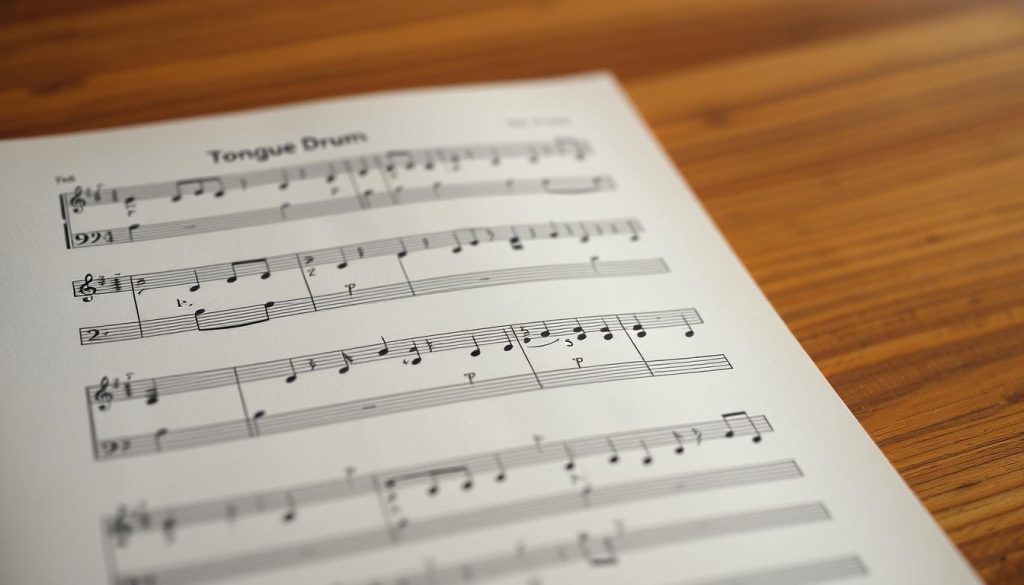
Reading, finding your place, and keeping time
Count the beats between notes, then group the strikes into bars. Cover the surrounding music so you can practise one bar slowly.
- 4/4 means four beats per bar; a quarter note lasts one beat.
- Start at 60 BPM with a metronome and gradually increase the tempo.
- Highlight repeated patterns and circle rhythmic changes.
Example and good habits
Look for matching numbers to read more quickly at sight. Learn in short sections: this instrument is well suited to brief phrases.
Useful notation for beginners: NMCA numbers, letter names, and symbols
A readable system helps you recognize each note without guesswork. This section introduces practical ways to read sheet music and start playing quickly.
NMCA: 1 to 7, octaves, and note lengths
NMCA uses the numbers 1 to 7: 1 = C, 2 = D, 3 = E, 4 = F, 5 = G, 6 = A, 7 = B. A dot above a number indicates the higher octave.
Symbols for note lengths work as follows: a dash doubles the length; a dot after a number increases it by 50%; a tie joins two identical notes into one sustained sound.
Letter names and good habits
Here is the A–G letter system: C = Do, D = Re, E = Mi, F = Fa, G = Sol, A = La, B = Si. Numbered or lettered stickers on the instrument make each note easier to identify.
- Tip: use a different color for each bar to find your place more quickly.
- Box repeated passages and mark changes in dynamics.
- Choose one system at first, numbers or letters, and switch later if needed.
Example: 3‑.‑ means E with a dot (+50%), followed by a dash that doubles the length. This notation supports clear, quick reading.
6-Note Tongue Drum Sheet Music: Song Ideas
Some classics work very well with a set of just six notes. Start with familiar tunes and organize your learning into short phrases.
Easy classics
Happy Birthday and Frère Jacques can be played in four-bar phrases. NMCA example: 5 5 6 | 5 5 1 | 5 5 6 | 5 3 2. Notes often last one beat; a dash doubles their length.
World music and nursery rhymes
Try nursery rhymes and tunes from around the world to explore different sounds without making the notation harder to read. Choose repetitive melodies: they help develop visual and rhythmic memory.
Building a progression
- Play slowly at 60 BPM, then increase the tempo.
- Repeat each line until you can keep a steady tempo.
- Compare letters and numbers: use the same score with different note labels.
- Mark rises and drops in octave so you can prepare each movement.
Tip: record your playing speeds, difficult passages, and number of repetitions. Online resources (TongueDrumTunes, PartitionsMusiquesGratuites, Instruments du Monde) offer versions arranged by level.
Playing techniques and method: coordinating your hands and controlling resonance
Choosing the right strike and controlling resonance immediately improve the sound. Hand coordination makes note sequences more even and stabilizes the tempo. Practise slowly with a metronome, then increase your speed gradually.

Fingers, mallets, and silicone finger covers
Playing with bare hands produces a natural tone but less volume. Felt mallets offer accuracy and greater projection.
Silicone finger covers help prevent fatigue during long sessions and protect your fingers without reducing dynamic control.
Managing rests, muting, and dynamics
Muting shapes resonance and creates precise pauses. Alternate between pianissimo and mezzo-forte to avoid an overloaded sound and preserve the pitch of the tongues.
“A well-placed rest is worth more than a poorly controlled long note.”
- Alternate left and right hands: begin with slow beats to a metronome, then play a short, repeated melody.
- Strike position: the center produces a longer sound; the edge gives a sharper attack.
- Record yourself from two distances to assess the instrument’s actual resonance.
| Technique | Comfort | Projection | Recommended use |
|---|---|---|---|
| Fingers | High | Medium | Quiet sessions, subtle dynamics |
| Felt mallets | Medium | Strong | Performance, accuracy |
| Silicone finger covers | High | Medium | Extended practice, protection |
Where to find reliable, free sheet music
Finding reliable sheet music makes progress easier and helps you avoid arrangements that do not suit your instrument.
Specialist sites: explore TongueDrumTunes (150 to more than 200 categorized melodies), DrumSheetMusic (community notation), and PartitionsMusiquesGratuites (printable PDFs). You can also visit Instruments du Monde to discover more than 50 traditional tunes.
How to save time
Filter scores by beginner level and musical style before downloading them. Use audio previews to hear an example.
- Select the “beginner” filter to avoid complex arrangements.
- Download printable PDFs to practise offline.
- Check the key and scale to make sure the piece is playable on your instrument.
Communities and feedback
Join Facebook groups such as “Tongue Drum France,” specialist subreddits, and YouTube channels. Share your recordings and ask for feedback on your reading.
- Choose a classic tune.
- Try a version in NMCA or letter notation.
- Save an annotated copy and note its key.
Tip: create a personal Pinterest board or a folder organized by genre to keep your favorite scores close at hand.
Create your own sheet music: a complete beginner’s guide
Creating your own sheet music turns a melody into a clear guide you can share. This guide explains which tools to use and how to make your layout easy to read.
Recommended tools: MuseScore (free, local editing), Flat.io (online collaboration), and ScoreCloud (audio capture → notation). Choose MuseScore for offline editing, Flat.io for working with others, or ScoreCloud if you prefer recording a sung idea.
Simple rules: space bars about 2.5 cm apart, use consistent symbols (dash = doubled length, dot = +50%, tie = sustain), and add colored annotations for each tongue or number.
Use a 4/4 time signature and phrases of 4 to 8 bars. Mark repetitions and specify the tempo. Clearly show your chosen system (NMCA or letters) with a small conversion table at the top.
“Always test the sheet music on your instrument before exporting it.”
A simple method: record your idea, simplify the rhythm, add the symbols, check the result on the instrument, then export an annotated PDF. To spark creativity, begin with a minimal pattern and document each version.
| Tool | Use | Advantage |
|---|---|---|
| MuseScore | Local editing | Free and feature-rich |
| Flat.io | Collaboration | Online sharing |
| ScoreCloud | Recording → sheet music | Quick way to capture ideas |
Practice plan and mistakes to avoid
Regular practice turns daily playing into measurable progress. Follow a simple method for 30 days: 20 minutes a day with specific goals.
SMART routine
Goal: play X bars fluently Y times. Start at a tempo of 60 BPM with a metronome.
- 5 min: warm up your fingers and work on resonance.
- 10 min: read slowly and repeat simple patterns.
- 5 min: consolidate your playing at a steady tempo.
Listening and recording
Record yourself each week to assess pitch accuracy, tempo, and fluency. Track your progress in a journal: speed, clarity of each strike, and note length.
Common mistakes and solutions
- Striking too hard → control the attack and use less force.
- Losing the tempo → read the score aloud while counting.
- Neglecting resonance → mute notes less and vary where you strike.
| Problem | Symptom | Action | Expected result |
|---|---|---|---|
| Striking too hard | Harsh, uneven sound | Strike closer to the center and use less force | Richer sound, better dynamics |
| Unsteady tempo | Hesitation | Count aloud and use a metronome | Steadier tempo |
| Poor resonance | Sound fades too quickly | Let notes ring longer and check strike position | More consistent resonance |
| Limited dexterity | Fingering mistakes | Targeted exercises for 2 to 3 minutes a day | More accurate playing |
Conclusion
With a simple method and reliable resources, playing soon becomes rewarding. Learn the symbols, choose short lines, and play slowly before speeding up. This approach supports learning and confidence.
This instrument is ideal for beginners: it lets you explore music through clear scores and accessible melodies. Repeating Happy Birthday is a useful milestone before adding other tunes.
Explore world music and nursery rhymes, then create your own sheet music. Track your progress, control resonance, and refine your finger movements. A few short, regular sessions are enough.
Finally, follow this guide, use reliable resources, and share your recordings with a community. Visual memory and reading line by line will help you gain accuracy, fluency, and enjoyment.