

Goal: this article offers a clear guide to reading and playing sheet music on an 11-note tongue drum.
Reading follows a simple pattern: from left to right and top to bottom. Each symbol refers to a specific tongue on the instrument.
We will explain two notation systems. In NMCA, the notes from C to B are numbered 1 to 7. In letter notation, they are represented by C, D, E, F, G, A and B. Dots above or below indicate the octave.
What you will learn: how to read, play and adapt sheet music to expand your repertoire. You will also learn to build a progressive practice routine.
Finally, we will briefly cover playing with your fingers or mallets, ergonomics and where to find reliable sheet music. Reading confidently helps you make the most of this instrument’s rich sound.
Why use sheet music for an 11-note tongue drum?
Using sheet music makes learning clearer and more reliable. Simple notation helps prevent memory lapses and lets you play more melodies accurately.
Reading sheet music helps beginners quickly locate each tongue on the instrument. Each number or letter calls for a specific action: strike the indicated tongue to produce the intended pitch.
Reading develops visual memory. You can identify notes without constantly looking at the instrument, building confidence in rehearsals and performances.
- Save time: the sheet music guides your work on difficult passages.
- Progress: move from uncertain memorization to confident reading of symbols.
- Creativity: reading frees your attention for expression and sound.
| Benefit | Practical effect | Who it helps |
|---|---|---|
| Fewer mistakes | Less hesitation during performances | Beginners and experienced musicians |
| Visual memory | Intuitive recognition of the tongues | Faster learning |
| Broader repertoire | Ability to play more pieces | All levels |
Essential reading cues: numbers, letters and reading order
Number and letter notation serve as guides when reading music.
In NMCA, C, D, E, F, G, A and B are numbered 1 to 7. This system is easy to read and helps you follow the melody.
Letter music notation uses C, D, E, F, G, A and B. Some scores use one system or the other; knowing how they correspond makes reading easier.

Octaves and accuracy
A dot above a number indicates the higher octave; a dot below indicates the lower octave. You may also see ° or * used as alternatives.
“D4 is an octave lower than D5: pay attention to the number after the letter.”
Reading order and alignment
Read each line from left to right, then move to the next. This rule prevents you from reversing the order.
- The same principle applies to numbers and letters: only the representation changes, not the pitch.
- Vertical alignment: play the melody and accompaniment together where their lines align.
- Duration and meter complete these pitch cues.
Tip: make a small chart matching NMCA numbers to the letters C, D, E… for quick reference. It will make everyday reading smoother.
Understanding what makes an 11-note tongue drum distinctive
An instrument with eleven tongues offers a good balance of sound range and compact size.
Models have between 6 and 15 playing areas. Eleven give you enough range for melodies and accompaniment without excessive complexity.
Typical layouts and finding the notes
Makers often alternate the notes of the scale to limit large jumps and make it easier to coordinate your right and left hands.
Tip: use the supplied stickers or colored markers to identify each playing area quickly.
Common scales
Common options include C major, D major, D minor and pentatonic scales such as Akebono.
- C major and D major: versatile scales for beginners and commonly available sheet music.
- D minor: a darker sound that gives the music a different character.
- Pentatonic scales: ideal for improvising without clashing notes.
| Criterion | Effect | Recommendation |
|---|---|---|
| Number of notes | Balance between range and compact size | 11 for developing players |
| Diameter | More low notes and resonance | 12 to 14 inches for a fuller sound |
| Octave doubling | A sense of fullness | Useful without complicating reading |
Listen to demonstrations before buying to make sure the scale and tone suit you.
In short: an eleven-tongue model suits beginners who want to read sheet music and develop their musicianship at their own pace.
11-Note Tongue Drum Sheet Music: Expand Your Playing
A wider range changes how you approach melodies and accompaniment.
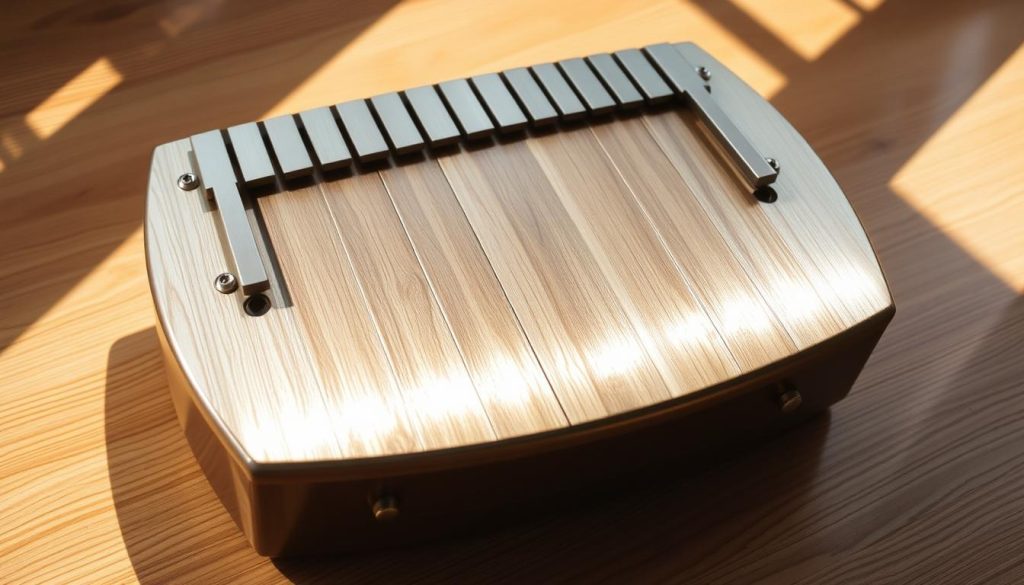
Why it makes a difference: more playing areas let you extend the main melody and add a simple bass line. You can also double notes at the octave if your instrument allows it.
When range changes your approach
Advanced scores often have two parts: melody and harmony. Follow their vertical alignment to strike the indicated notes together.
Reading chords and doubled notes
Parentheses, as in (1-6), or a hyphen, as in 1-6, indicate notes struck together. This creates simple chords or doubled notes that reinforce the melody.
- Start simply: choose scores with a sparse harmony part.
- Work in stages: play the melody alone, then the harmony alone, before combining them.
- Find the bass notes: the tonic and dominant help anchor the accompaniment.
| Feature | Effect | Advice |
|---|---|---|
| Wider range | Longer melodies | Choose a scale that suits your repertoire |
| Parentheses and hyphens | Simple chords | Focus on synchronizing both hands |
| Octave doubling | Fuller sound | Use it to strengthen the melody without complicating reading |
“A well-chosen instrument offers a good balance between musical possibilities and readable sheet music.”
Rhythm, meter and tempo: reading and feeling the beat
Understanding rhythmic structure helps you play each note at the right moment. The time signature shows how beats are organized, and vertical bar lines divide the measures.

Measure numbers: these show your position and make it easier to resume playing or communicate with other musicians.
Rests, dots and ties
A 0 or a blank space marks a rest; silence shapes phrasing just as much as the notes you strike. Ties extend a note without another strike, reducing movement and preserving resonance.
Duration: dashes and lines
A dash lengthens a note, while a line beneath a number shortens it. One dot adds half the note’s value; two dots add 75%.
- Metronome advice: start slowly, for example at 60 to 80 BPM. Once the rhythm is steady, gradually increase to 120 BPM if needed.
- Practical tip: count the beat quietly and isolate recurring rhythmic patterns to make reading more automatic.
“Listening to the silences and resonance changes how you feel time in music.”
Playing techniques: mallets, fingers and protection
Playing with your fingers or mallets profoundly changes your musical expression on this instrument.
Fingers: quick and precise, they let you play fast passages clearly. They work well for detailed percussive patterns and articulated passages.
Mallets: they produce more volume and sustain. Their hardness changes the attack and brightness, making them suitable for sustained textures and accents that fill the space.
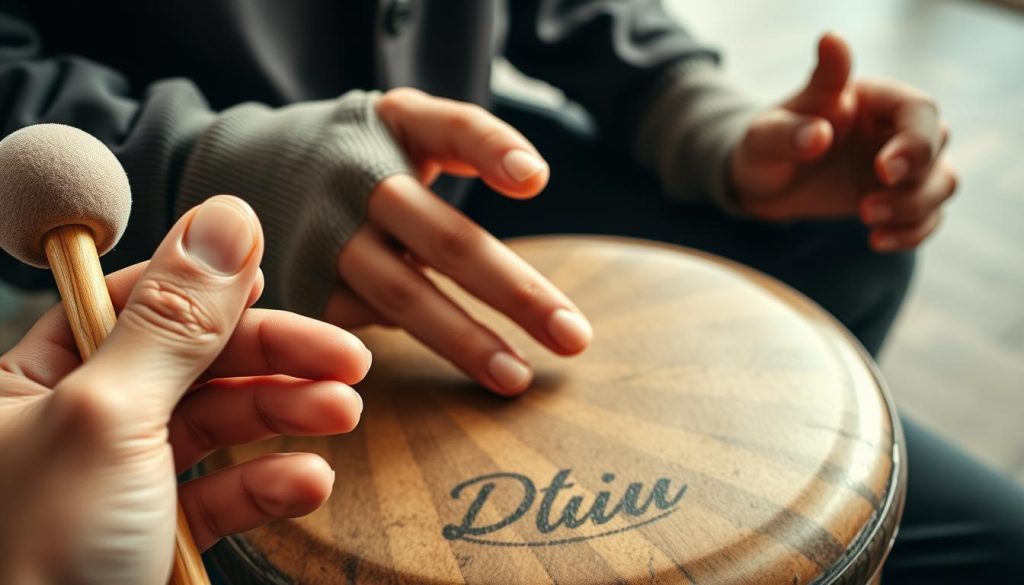
- Try both on the same passage to compare clarity and endurance.
- Protect your hands: finger covers and tape can help prevent irritation during long sessions.
- Ergonomics: keep a stable posture, place the instrument in front of you and alternate hands to spread the effort.
“Mark F for fingers and M for mallets on your scores to keep your practice consistent.”
| Aspect | Fingers | Mallets |
|---|---|---|
| Feel | Agility, articulation | Volume, resonance |
| Suitable music | Fast patterns, ornaments | Sustained textures, held chords |
| Practical advice | Speed exercises, frequent breaks | Try different mallet hardnesses and listen to the sustain |
Final tip: compare both techniques to hear the differences in dynamics and sustain. Pay attention to how your hands feel and take regular breaks to avoid fatigue.
A progressive practice routine for 11 notes
Begin each session with a short, focused warm-up. Play ascending and descending scales, followed by a few diatonic arpeggios. Alternate hands to improve coordination.
Warm-up and reading
Guided reading: sight-read short melodies. Then add a simple accompaniment part below. Practice each hand separately before combining them.
Rhythm and meter
Practice rhythmic patterns containing quarter notes, eighth notes and syncopation. Always observe the rests and use a metronome to steady your rhythm.
Expression
Work on dynamics and accents. Mark dynamic instructions on your scores and vary your articulation as indicated.
- Record your progress: BPM reached and passages mastered.
- Alternate days devoted to technique with days devoted to repertoire.
- Finish with 5 minutes of free exploration to stimulate creativity.
| Goal | Duration | Advice |
|---|---|---|
| Warm-up | 5 to 10 min | Scales and arpeggios, alternating hands |
| Guided reading | 10 to 15 min | Short melodies, then accompaniment |
| Rhythm and expression | 10 min | Metronome, rests and accents |
“Regular practice sharpens reading and musical understanding.”
Create, adapt and read sheet music: from ear to page
Start by identifying the pitches missing from your instrument. Mark any notes outside its range immediately.
Adaptation method: identify unavailable pitches, then replace them with the same note in another octave or a nearby scale degree. Above all, preserve the main melodic line.
Adapting music for 9, 13 or 15 notes to an 11-note instrument
Simplify the harmony: remove unnecessary doubled notes and reduce the number of notes in chords. Rewrite bass notes that fall outside the instrument’s range.
Transposing to suit the scale
Choose a compatible key, such as C major, D major, D minor or a pentatonic scale. Transpose the entire melody to make it as easy to play as possible.
| Step | Action | Purpose |
|---|---|---|
| Identify | List the missing pitches | Clarity |
| Substitute | Use the same note in another octave or a nearby scale degree | Preserve the melody |
| Notate | Mark changes on the line | Make the score easier to read |
- Try several variations and keep the one that sounds best.
- Exercise: transpose a nursery rhyme from C to D, then adapt it to a minor scale.
“A successful adaptation lets you play more pieces without changing instruments.”
Where to find and how to choose steel tongue drum sheet music
Reliable sources make it much easier to find sheet music suited to your instrument.
Online resources: you can find free files on Pinterest, in educational libraries and in booklets supplied by manufacturers. ZenaPan offers a booklet of 13 pieces and 30 video tutorials. Beat Root, Hapi Drum, Metalsounds/Zenko and Moozica offer demonstrations and downloadable sheet music.
Quality criteria
Check readability: clear type, sufficient contrast and a distinct separation between melody and accompaniment. Look for measure numbers, a tempo in BPM and an explanation of duration symbols.
- Favor scores that show rests, using 0 or spaces, as well as ties and dots that extend notes.
- Listen to accompanying demonstrations to check the pitches and the musical result.
- Organize your finds by scale, difficulty and style to save time.
| Source | Strength | What to check |
|---|---|---|
| Manufacturers (ZenaPan) | Booklets and video tutorials | Clarity of notation, tempo in BPM |
| Pinterest and libraries | Many free resources | Variable quality; check readability |
| Specialist sites (Beat Root, Moozica) | Demonstrations and organized collections of sheet music | Pitch accuracy and rhythm explanations |
“This article offers a practical checklist to help you sort through scores quickly and save time.”
Conclusion
A clear reading method helps you make real progress.
Understanding numbers and letters, reading order, octaves and duration symbols gives you the foundation for following a score. Progressive practice with scales, arpeggios and rhythmic patterns, using a metronome, improves accuracy and musicality.
Reading sheet music opens up a wider repertoire, reduces mistakes and strengthens visual memory. An eleven-tongue instrument offers a good balance between the number of notes and ease of reading, making it ideal for melodies and accompaniment.
Choose clear scores that show measures, tempo in BPM, rests and ties. Try fingers and mallets to find the sound you want. Adapt or transpose pieces when necessary. Find resources and free sheet music in our sheet music selection, and play pieces several times: repetition often makes playing feel more natural.