
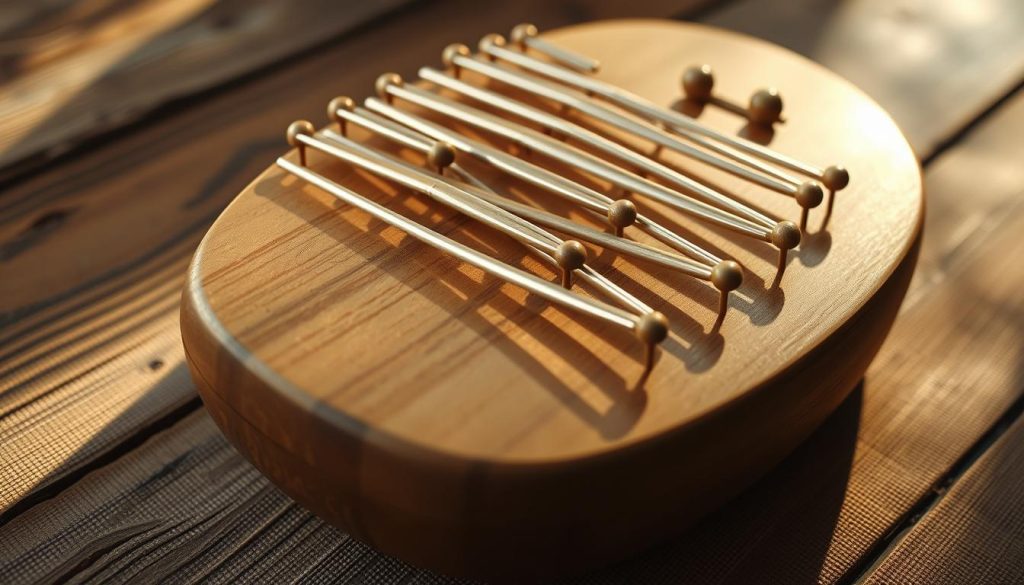
Made in Besançon, this compact instrument invites you to play as soon as you pick it up. Its small footprint, manageable weight and finishes reflect a design suited to everyone, from beginners to regular players.
Simple and reassuring, it offers six preset scales and a magnetic tuning system that lets you change settings in seconds. Whether you play with your hands or mallets, you can enjoy it immediately without worrying about wrong notes.
Its acoustic and electroacoustic design lets you explore soothing sounds or amplify the instrument for the stage. A jack output and piezo pickup make recording and amplification easy.
Fast delivery, a one-year warranty and included accessories add to its practical appeal. This introduction sets up a review focused on everyday uses: relaxation, creativity and easy recording.
A quick introduction to the Beat Root Multiscale and its musical possibilities
Move from a cheerful sound to an intimate mood without interrupting your playing. In seconds, the magnetic mechanism lets you select one of six ready-to-play settings.
Each scale has been carefully chosen to evoke a range of moods: Happy for joy, Zen for relaxation, Tribal for energy, Melancholia for depth, Space for a dreamlike feel and Nature for soothing clarity.
The idea remains simple and accessible. No music theory is required, and there are no wrong notes: you can get started in minutes. Play with your hands or the included mallets, depending on the sound you want.
- Flow: switch settings as you play to keep your creative momentum.
- Versatility: six different scales for relaxation, joy or inner peace.
- Ease of use: the same eight tongues serve every setting, making playing patterns easier to remember.
Whether you are new to music or an experienced musician, this instrument can become an everyday companion. The color coding helps you explore its sounds and find the mood you want in seconds.
Beat Root design, construction and specifications
This instrument has a compact shape designed for comfortable playing and easy transport.
Construction: a hollow shell made from a proprietary alloy, sturdy and stable. Its small pot-like shape feels comfortable to play. You can rest it on your lap or place it on a snare drum stand.

Dimensions, playing surfaces and finishes
Specifications: a compact 30 cm diameter, 17 cm height and 5 kg weight. The laser-cut tongues vibrate clearly and produce distinct notes with balanced sustain.
Electroacoustic features, accessories and quality
Equipped with an internal piezo pickup and a 6.35 mm jack output, it connects directly to an amplifier or audio interface. The included mallets give you a clear attack from the first time you play.
- Made in France: finishing and tuning are carried out in Besançon, with careful quality control.
- Adjustability: a magnet beneath the tongues changes the tuning without disassembly.
- Overall feel: careful assembly, even paintwork and a solid feel in everyday use.
In short, the Beat Root combines a small diameter, manageable weight and electroacoustic features in an instrument that is easy to carry and play. For more technical details, consult the product information.
Beat Root: The Multiscale Tongue Drum Explained — Our Review
A simple, quick mechanism lets you move between moods without a complicated setup.
How it works: the tuning system uses magnets placed beneath the tongues. One magnet lowers a note by a semitone; two magnets lower it by a whole tone. A printed diagram inside shows where to place the magnets using color coding.
The settings and their colors
Happy (G major): no magnets. A bright mood and a straightforward G scale.
Zen (G minor): green and yellow markers create an intimate, relaxed sound.
Tribal: a red marker, a pentatonic scale and an adventurous energy.
Melancholia: green, yellow and blue markers create deep, moving textures.
Space: two red markers and one green marker create a cinematic atmosphere.
Nature (G major): yellow and blue markers bring serenity and vitality.
The precise magnets and clear markers let you change settings reliably in seconds. The notes in each scale follow a thoughtful pattern, making sequences easier to play and remember.
Sound, playability and uses: hands, mallets, stage and studio
Its size and responsiveness allow expressive playing with your hands or mallets. The instrument rests naturally on your lap or on a snare drum stand when you play standing up.

Playing techniques and sound control
When playing by hand, use your fingers, palm or fingertips for velvety sounds. Mallets produce a firmer attack; choose soft mallets to preserve the richness of the notes.
Control the dynamics by varying how hard you strike. Dampen notes at the center or rest your fingers lightly on them to shorten their sustain. To play several notes at once, combine your thumb, index finger and middle finger to form chords and arpeggios.
Electroacoustic features and effects
The internal piezo pickup and 6.35 mm jack output let you connect the instrument to an amplifier, audio interface or PA system. Add reverb, delay, chorus, flanger or a looper to expand your creative options in the studio.
On stage, a volume pedal helps you adjust the level without interrupting your playing.
Practical applications
Ideal for relaxation, sound therapy, early music education or quick studio recording. In workshops, alternate between hands and mallets to vary the textures and layer parts with a looper.
| Position | Technique | Sound | Suggested use |
|---|---|---|---|
| On your lap | Fingers and palm | Velvety sound, controlled sustain | Relaxation, teaching |
| Standing, on a stand | Soft mallets | Clear attack, greater projection | Stage, rhythm |
| Connected by jack | Volume pedal and effects | Processed atmospheres, loops | Studio, performance |
| In an ensemble | Hands and mallets | Varied textures | Accompaniment, composition |
Comparisons, advantages, drawbacks and overall value
In practical terms, this model offers a wider range of sounds than many other instruments in its family.
Compared with handpans, which are often tuned to a single scale and sold for €1,500 to €3,000, this Beat Root instrument may be an alternative. It offers six different scales, a compact 30 cm diameter and a more accessible price, such as €448.

Compared with handpans and other instruments
Advantage: the magnet system and colored markers let you change the mood without changing instruments. Its compact size makes it sturdier and easier to transport than a handpan measuring around 60 cm.
What we like and what we like less
- What we like: the warm sounds, quick scale changes, stable magnets, easy-to-carry size and the option to connect it to an amplifier for studio and stage use.
- What we like less: the high notes can be subdued, volume may be limited when playing by hand, and the markers need some attention, especially to maintain their adhesive.
“Users highlight the pleasure of playing it and its sturdy construction.”
Price, delivery and warranty
Value: at its asking price, this Beat Root instrument offers a competitive balance of features and cost. Orders placed before 2 p.m. ship the same day, delivery takes two days on average via UPS, shipping is free in France and Europe, and the warranty lasts one year.
Is it useful if you want versatility? Yes. For the studio? Yes. For an unamplified stage performance? Its volume may be limited. To explore several moods without a large budget? Certainly.
Conclusion
This compact instrument emphasizes accessibility and immediate inspiration. The versatile Beat Root combines French manufacturing, built-in electronics and six ready-to-play scales.
Its compact size (30 cm, 5 kg) and system of magnets and markers let you change the mood in one move. Each setting offers approachable notes, from a G major foundation to more introspective sounds.
At home or in the studio, played by hand or with mallets, the instrument offers many possibilities and encourages lasting creativity. To go further and learn how to combine these instruments, consult this guide.
Buying advice: if you want a simple, inspiring and durable option, this Beat Root deserves your attention. It requires little preparation and offers plenty of possibilities.