
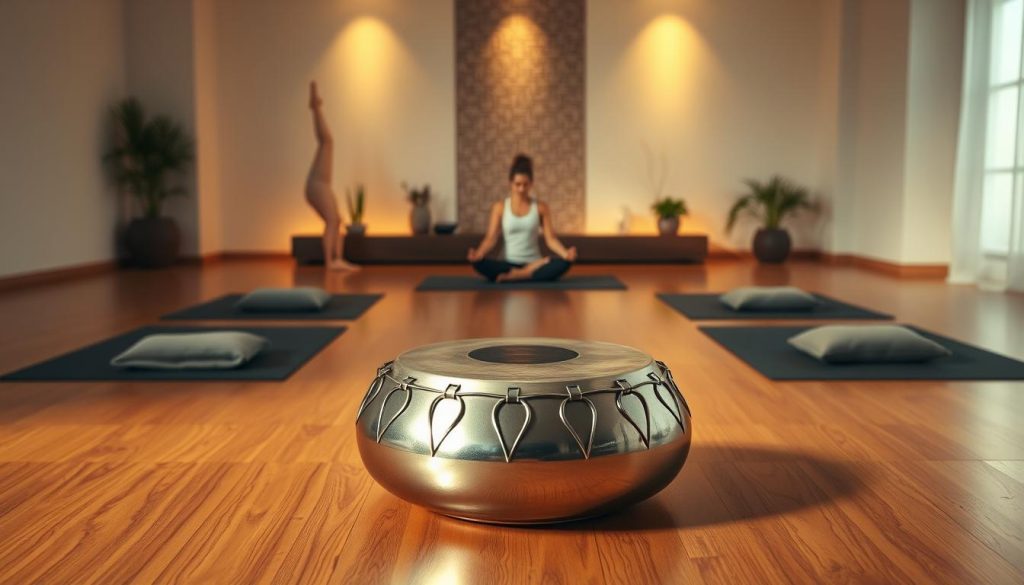
Goal of this guide: show how to incorporate a tongue drum into a daily practice to support lasting relaxation and a sense of presence.
This instrument produces enveloping sounds that resonate for a long time. They make it easier to concentrate, even for beginners who cannot read music.
We offer a step-by-step guide to choosing a tuning, playing mindfully, positioning the instrument, and leading short sessions lasting just a few minutes.
Combining movement, breathing, and music helps relax the nervous system and calm the mind. The benefits for body and mind can be felt quickly.
The aim is to turn each session into an immersive experience through harmonious sounds and a progression from simple to more advanced exercises.
Below, you will discover why these practices work well together, essential routines, instrument preparation, playing and breathing techniques, tips for a live session, and criteria for choosing and caring for an instrument.
Why combine the tongue drum and yoga for deeper relaxation?
Notes played live can guide breathing and anchor attention. Meditation and music have scientifically recognized effects, including reduced stress, improved concentration, and cardiovascular and immune benefits.
The rich, deep sounds of a tongue drum make it easier to enter a stable meditative state. Their gentle attack and long resonance reduce mental effort and support attention.
The vibrations produced by this instrument strengthen the mind-body connection. They help release emotional tension and improve proprioception, which is useful before or after asanas.
Live music or recordings: why live playing works better
A musician playing live can adapt the tempo and volume to the practitioner’s breathing. Alternating sounds with silence increases awareness of the vibrations and strengthens stress reduction.
For practical resources, consult a guide to incorporating sound, such as incorporating this instrument into a session.
Tongue drum and yoga: meditation routines
Begin a short session by matching your breath to the notes so you can quickly feel present. This approach supports frequent, effective sessions: for example, 10 minutes a day instead of one long session each week.

Quick 5-to-10-minute routine
Spend 1 minute listening to silence, 3 minutes breathing steadily through your nose, 3 minutes playing slow patterns on 2 or 3 notes, then 2 minutes slowing your playing to enter a meditative state.
Breathing and sustained notes
Sustaining a note during the exhale and playing a gentle interval on the inhale helps steady the heart rate. Synchronize your strikes with your breathing to anchor attention.
Yin and note mantras
Choose two note mantras and repeat them during long-held poses to encourage a deep meditative state while staying attentive to your body.
Savasana guided by gentle sounds
Play the instrument quietly. Space out the gentle sounds and let each note fade away to support relaxation.
“Simple pattern: 1-5-6 in slow loops, followed by a sustained note on the exhale.”
| Duration | Action | Goal |
|---|---|---|
| 1 to 2 minutes | Listening in silence | Initial grounding |
| 3 to 6 minutes | Slow patterns (1-5-6) | Enter a meditative state |
| 1 to 2 minutes | Slowing down and sustaining a note | Relaxation and integration |
Practical tips: place the instrument on a stable support, keep your wrists relaxed, and strike lightly. Record the details of each session: the time, bodily sensations, and patterns that help you most to enter a meditative state.
Preparing the instrument for practice: tuning, scales, and frequencies
Preparing the instrument helps your practice flow smoothly: tuning, scale, and frequency all matter.
Identify the tuning by checking the stickers on each tongue or reading the instructions. Count the notes: 7 for a diatonic scale, 5 for a pentatonic scale.
Pentatonic or diatonic scale: a pentatonic scale makes harmonious playing easier. All its notes work together, reducing the fear of playing a wrong note.
Adapting a diatonic instrument
To turn a major scale into a pentatonic scale, skip degrees 4 and 7 (F and B). Mark those tongues with red stickers so they are easy to avoid.
Testing three central notes lets you check how well the sounds work together and how long they resonate before each session.
Choosing the right frequency
A tuning of 432 Hz is often perceived as gentler and more conducive to deep relaxation. 528 Hz is recommended in sound therapy for a restorative effect.
If relaxation is your goal, choose an instrument tuned to a pentatonic scale at 432 Hz.
| Check | Action | Result |
|---|---|---|
| Identification | Check the stickers or instructions | Determine whether the instrument has 5 or 7 notes |
| Marking | Put red stickers on degrees 4 and 7 | Avoid dissonance |
| Quick test | Play 2 or 3 central tongues | Check the resonance and how long it lasts |
| Frequency | Choose 432 Hz or 528 Hz | Match the desired effect: relaxation or sound therapy |
“With a pentatonic scale, you can improvise freely without worrying about wrong notes.”
Playing and breathing techniques for a flowing session
Combining breath and movement creates a rhythm that supports concentration and relaxation of the body. Start by placing the instrument on a stable support and relaxing your shoulders.

Fingers or mallets: choosing your touch
If you play with your fingers, use your fingertips for a soft, organic sound. Vary the pressure slightly to change the tone.
With mallets, keep your hand relaxed and strike without pressing into the tongue, so the note can resonate.
Note mantras and a slow tempo
Choose 2 or 3 central tongues to create a note mantra. Repeat it at a slow tempo, guided by your breathing rather than a metronome.
“Inhale for 4 counts, exhale for 6 counts, and strike a note at the end of each exhale.”
This simple method helps lengthen the breath and synchronize movement with sound. Add a pause after every 3 or 4 loops to give your ears a rest.
Active listening and practical adjustments
Wait for the resonance to fade before choosing the next strike. This steadies concentration and deepens attention.
Alternate your right and left hands to balance your playing. Between loops, briefly notice how your body feels to avoid tension and stiffness.
Care tip: wipe the instrument after use, avoid moisture, and, if possible, place it on a wooden support to improve the sound.
To explore how to incorporate sound into a session, consult this practical guide: how to use a tongue drum.
Designing a yoga session with live tongue drum music
Designing a session around sound means balancing your intention, the space, and your musical choices.
Live music or recordings: live playing lets you adjust the tempo and volume in real time. This supports transitions between poses and encourages deeper relaxation.
Recordings provide consistency and simplicity. They are useful for repeating a planned sequence and making sessions easier to organize.
Playing yourself or collaborating
Playing yourself works well for gentle classes and at the beginning and end of a session. For dynamic sequences, another musician is preferable so the teacher can remain attentive to the participants.
Mindful playing: placement, volume, and atmosphere
- Place the tongue drum at the front, slightly off-center, to spread its vibrations without drowning out the voice.
- Keep the volume below that of the voice guiding the session, and lower it during inward-focused phases.
- Arrange the space with mats and drapes, and define an area to help manage the acoustics.
Simple sequence: open with 3 minutes of widely spaced sounds, follow with a central section synchronized with breathing, then close with silence followed by 2 or 3 long-resonating strikes.
Encourage inner listening and awareness of the body during yoga sessions. Avoid fast or percussive patterns, which stimulate rather than soothe.

To learn more about 432 Hz tuning, read about its benefits and limitations.
Choosing and caring for a steel tongue drum for yoga
Choosing a good instrument affects the quality of the sound and the depth of each session. For a practice centered on relaxation, choose a medium or large model. Models at least 30 to 33 cm across produce more noticeable vibrations and lower notes that are useful for reaching a deep meditative state.
Size, number of notes, and a practical example
Small models: 6 to 8 notes (6 to 10″). Medium models: 9 to 12 notes (10 to 14″). Large models: 13 to 15 notes (14 to 22″).
Example: a 12″ tongue drum with 11 notes, tuned to a pentatonic scale at 432 Hz, is a good choice for starting a regular, calming practice.
Materials and tuning
Stainless steel: a clear tone and long resonance. Titanium alloy: rich resonance and durability. Choose a corrosion-resistant finish.
432 Hz supports relaxation; 528 Hz is used in sound therapy. Try the instrument and notice how it feels before buying.

Care, transport, and positioning
- Wipe the instrument after each session and lightly oil steel models.
- Store it in a padded case and protect it from moisture and knocks.
- Place it on a wooden support to improve its resonance, and leave space around the mat.
“Regular care preserves the accuracy of the notes and the beauty of the gentle sounds for years.”
For a concrete example, explore a 14” steel-and-titanium model that combines resonance and durability.
Conclusion
In short, this instrument makes meditation accessible. Its harmonious sounds make it easier to enter a state of presence, even during short sessions.
Remember the stages of the progression: choosing a tuning and frequency, practicing briefly, playing mindfully, and designing sound to support deeper relaxation.
Plan 2 or 3 ten-minute sessions a week to establish the habit. You can play yourself or invite a musician, and use live music or a recording, depending on your intention.
Care and quality matter: choose a suitable instrument and look after it to preserve its effects and the beauty of its notes over the years.
Finally, experiment with different placements, volumes, and tempos. Regular, attentive practice can turn each session into a moment of deep grounding supported by subtle vibrations.